搞笑一家人
‘2026 version of Journey to the West’ goes viral as classic comes alive in young people’s everyday lives_我的网站

一 |
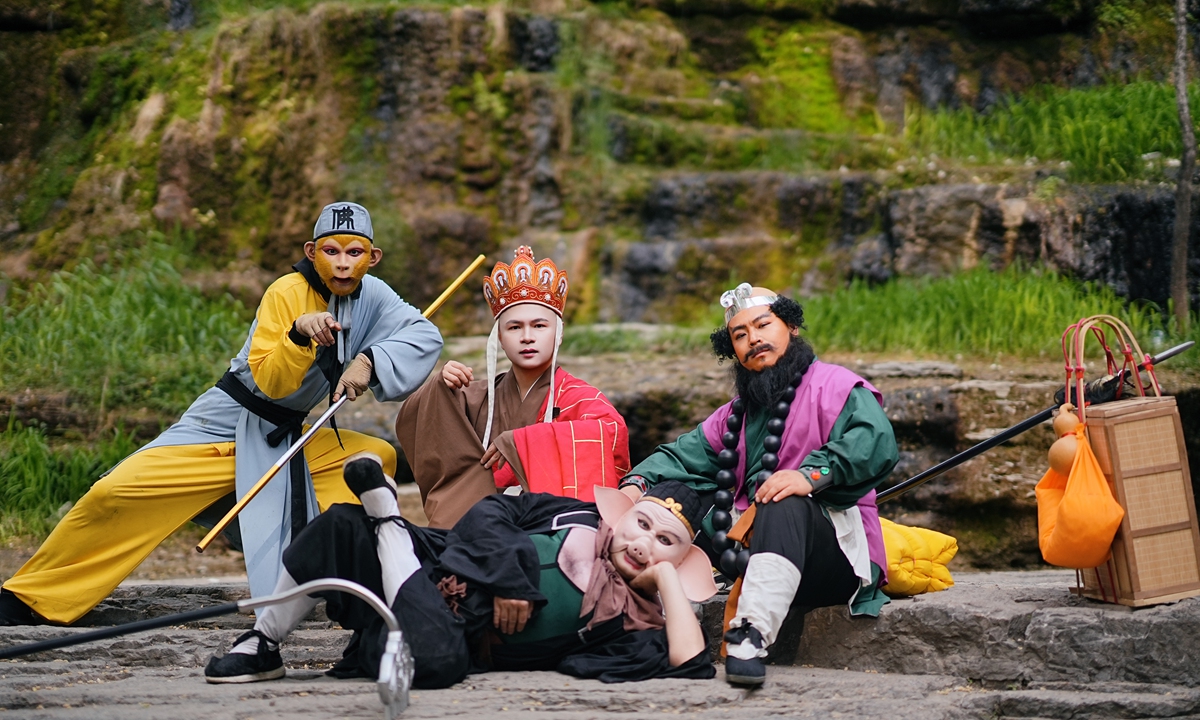
Livestreaming team of Journey to the West: Heroes' Gathering, featuring the four master-disciples Photo: Courtesy of the cast team of
Journey to the West: Heroes' GatheringAt dusk, in an unassuming grove in Shouguang, East China's Shandong Province, performers dressed as Tang Sanzang (Monk Xuanzang), Sun Wukong (Monkey King) and other characters from the renowned Chinese classic Journey to the West set up a thatched hut and cooked around a bonfire while livestreaming. They were not fighting demons or embarking on a pilgrimage, but chatting, joking and improvising in response to comments from live viewers.
This seemingly makeshift
Journey to the West: Heroes' Gathering livestream has gone viral lately, with related videos garnering more than 140 million views and more than 400,000 viewers tuning in simultaneously at its peak on Douyin, the Chinese version of TikTok. Netizens gave it a distinctly contemporary nickname — the "2026 version of
Journey to the West."
Behind the viral success is a format far removed from traditional film and television productions: The livestream does not rely on tightly scripted dialogue.
Gao Guancheng, director of the team, told the Global Times that the team usually prepares only a basic outline before each livestream, leaving about 80 percent of each livestream to improvisation.
"Comments from viewers, trending internet memes, and even unexpected incidents on site can all become the starting point for the next scene," he said. This seemingly spontaneous approach, however, is far from unprepared.
Into daily lifeThe performers playing the "four pilgrims" all have years of experience portraying characters from
Journey to the West. That experience has given them the chemistry needed to pick up and build on one another's cues during livestreams.
"The actor playing Tang Sanzang has years of rich experience imitating the character, the actor playing Sun Wukong has studied monkey opera since childhood, and the actor playing Zhu Bajie has been portraying the character for nearly 20 years," Gao said.
"One look, one movement, or one punchline, we all know who should pick it up and who shouldn't," he added.
That chemistry may be the foundation for bringing the characters to life, but what truly connects this new
Journey to the West with contemporary life is the seemingly ordinary daily routine.
Peng Tao, a young viewer in his 20s who works in the internet industry, told the Global Times that when he first came across Journey to the West: Heroes' Gathering, he felt as if he were watching a spin-off of Journey to the West, one in which familiar characters were simply going about their daily lives.
"In the past, we saw them on the pilgrimage and fighting the demons. Now we see them eating together, chatting and working. That contrast really draws me in," he said.
In his view, the relationships among Tang Sanzang and his disciples remain familiar, but placing them in everyday situations gives those relationships a new resonance.
"For example, at work, there may be a relatively domineering boss, someone who always rushes to take responsibility, someone who keeps the atmosphere lively, and someone who doesn't say much but always gets things done in the end. You start to feel that they're no longer mythical figures, but people around you," he said.
That sense of familiarity may be one way for classics to reconnect with younger audiences.
"I don't think they are doing
Journey to the West a disservice," Peng said. "The basic personalities of the characters are still there; they've simply been placed in a new setting. If a classic can only be told in the same way it was decades ago, it may actually become increasingly distant from young people."
Finding the right balance between the old and the new is also something the creators of
Journey to the West: Heroes' Gathering have been thinking about.
"We are not remaking
Journey to the West. By preserving the basic characteristics of the characters while placing them in new everyday settings, we are bringing Journey to the West into the lives of ordinary people," Gao said.
Stories reimagined
The modern revival of classic traditional classics is by no means limited to Journey to the West.
Classic Chinese texts taught in schools, including
Letter to Wife,
Pipa Song and
The Golden Fishhook, have also been turned into vivid and engaging short videos. One video based on
The Golden Fishhook has garnered more than 100 million views. Such adaptations have attracted widespread attention online, according to the Beijing Daily.
These time-honored texts have become part of a generation's collective memory and naturally come with an established audience. Yet with countless classics to draw from, there is no shortage of adaptations that simply capitalize on established IPs or recycle old memes, and not every adaptation wins over audiences. What truly resonates is finding a thoughtful way to bring classics back down to earth, according to the Beijing Daily.
Beijing-based cultural scholar Wang Deyan told the Global Times that the vitality of a classic does not lie simply in repeating it word for word, but in its ability to continually forge new connections with contemporary life, emotions and aesthetics.
"Classics can continue to resonate in new eras because the relationships between their characters, their emotional structures and the values they convey can still connect with people today," he said.
In Wang's view, the popularity of
Journey to the West: Heroes' Gathering is essentially a way for young audiences to rediscover a classic through new forms of media: The characters remain the same, but the way audiences view them has changed.
"Short videos, livestreams and online fan creations have lowered the threshold for creative expression, giving classics opportunities to enter more tangible settings of everyday life," he said.
Perhaps classics truly come "alive" in moments like these, when they are no longer simply "old stories" preserved in textbooks and on screens, but enter livestreams, short videos and the everyday lives of young people, gaining new vitality in a new era through each retelling and each new way of being seen.
。 中新社北京8月23日电 (记者 周昕 李京泽 迟瀚宇)应中国教育国际交流协会邀请,支持中国治沙事业的美国友人“赛考斯”(本名罗纳德·萨科尔斯基)23日凌晨抵达北京首都国际机场。时隔20多年,第三次来到中国的赛考斯难掩激动,刚一露面,就用不太流利的中文说出:“我回来了!”
1999年,跟随“中美教师交换项目”来到中国任教的美国教师萨科尔斯基筹集5000美元,帮助殷玉珍夫妇治沙造林。如今,5000美元长成5万多棵大树,赛考斯跨越万里,也即将迎来与故友殷玉珍的重逢。
8月23日凌晨,支持中国治沙事业的美国友人“赛考斯”(本名罗纳德·萨科尔斯基)抵达北京首都国际机场。 中新社记者 富田 摄
历经十余小时的跨洋飞行,赛考斯直言丝毫没有疲惫之感。“当飞机落地时,我意识到自己回到了第二个家,即将见到我的‘家人’。”对他来说,此行就像“一个快乐的小孩在过圣诞节”。“快乐的小孩”很关注自己的行李箱,里面有他精心为中国朋友准备的礼物。
对于赛考斯而言,此番来华是一场圆梦之旅——看望治沙英雄殷玉珍、见证成片林木的成长,与昔日学生和老友重逢,是他长久以来的心愿。

二 | 他感慨,当年一次小小的善意资助,竟孕育出片片绿洲,这是他从未想过的美好结果。“我想对殷玉珍说声谢谢,她让中国更加美丽。”
“这是一段由上天书写的故事,我只是扮演好自己的角色,殷玉珍才是真正的英雄。我即将要去的那片森林,会揭开这个故事的全新篇章。”赛考斯期待,等到行程结束,可以向世界传递清晰信号:美中两国可以跨越差异、携手合作,共建和平世界。

三 | “就像是荒漠化防治,两国要把关注点放在共通之处,秉持开放心态,守护和建设更加美好的世界。”
赛考斯正式开启为期10天的中国之旅,后续还将到访内蒙古鄂尔多斯、呼和浩特及河南洛阳,再续两国民间友谊。(完)
【编辑:刘欢】。
Current article:http://q6afe7b.sunaichitikouchua.bond/o8kcd0/20260826/597337.html
Published on:10:33:29